The stock market's best and worst days tend to arrive together, and the early months of 2026 offered a timely reminder. The S&P 500 fell nearly -10% from its late-January high through the end of March as the U.S.-Iran conflict sent oil prices surging more than +60%. Headlines about the Strait of Hormuz closure, rising energy costs, and the potential economic impact created an environment that can tempt investors to move to cash. But acting on that impulse would have meant missing the recovery that followed when ceasefire talks emerged in late March. It is a well-documented pattern: trying to avoid the worst days often means missing the best days.
Figure 1 illustrates this dynamic. The chart graphs the S&P 500's daily returns over the past 26 years, showing that the market's largest daily moves cluster together rather than occurring in isolation. The biggest single-day selloffs during the 2008 financial crisis, the 2020 pandemic, and the 2025 tariff volatility were each surrounded by some of the largest single-day gains. The pattern showed up again during the recent volatility: the S&P 500 posted its strongest daily return since April 2025 amid optimism for a U.S.-Iran ceasefire, only days after escalating tensions pushed stocks lower. The same environments that produce sharp selloffs often set the stage for strong rallies.
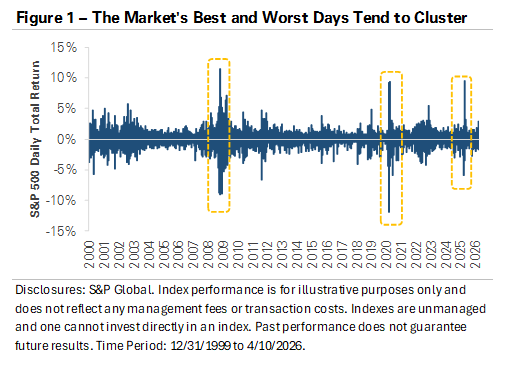
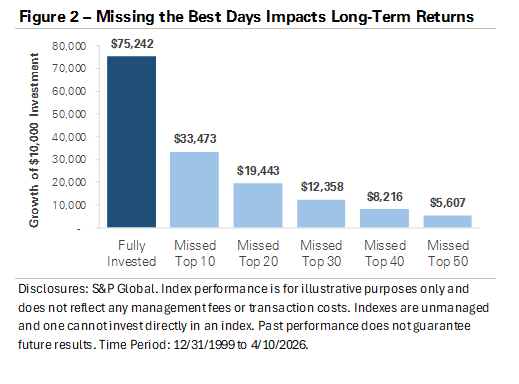
Figure 2 puts a dollar amount on the cost of mistiming the market. A $10,000 investment in the S&P 500 on December 31, 1999, would have grown to $75,242, a more than seven-fold increase over a period that included the dot-com bust, the financial crisis, and a global pandemic. Missing just the 10 best trading days cuts that ending value to $33,473, less than half the fully invested result. The damage compounds quickly from there: missing the top 20 days reduces the value to $19,443, missing the top 30 lowers it to $12,358, and missing the 50 best days shrinks the original $10,000 to $5,607, a loss of more than -40% during a period when the market delivered strong returns.
This year’s market volatility may feel unsettling, but it reinforces a core principle: selling during a decline locks in losses and creates a difficult re-entry problem. Investors who moved to the sidelines during March’s selloff and waited for calmer conditions likely missed a significant portion of the recovery. A well-constructed financial plan accounts for periods of market stress, and strategies like maintaining a diversified portfolio, keeping an appropriate cash reserve, and rebalancing periodically can help investors stay the course. The market rewards patience, and as the first quarter showed, mistiming it can be costly.
Important Disclosures
Views expressed are as of the date indicated, based on the information available at that time, and may change based on market or other conditions. Investment decisions should be based on an individual’s own goals, time horizon, and tolerance for risk. Investing involves risk, including risk of loss. Investment advisory services provided by Provident Financial Planning, LLC, a SEC-Registered Investment Advisor.
The information and opinions provided herein are provided as general market commentary only and are subject to change at any time without notice. This commentary may contain forward-looking statements that are subject to various risks and uncertainties. None of the events or outcomes mentioned here may come to pass, and actual results may differ materially from those expressed or implied in these statements. No mention of a particular security, index, or other instrument in this report constitutes a recommendation to buy, sell, or hold that or any other security, nor does it constitute an opinion on the suitability of any security or index. The report is strictly an informational publication and has been prepared without regard to the particular investments and circumstances of the recipient.
Past performance does not guarantee or indicate future results. Any index performance mentioned is for illustrative purposes only and does not reflect any management fees, transaction costs, or expenses. Indexes are unmanaged, and one cannot invest directly in an index. Index performance does not represent the actual performance that would be achieved by investing in a fund.
Subscribe to receive the latest blog posts to your inbox every week.
Explore our expertly curated articles offering deeper knowledge and understanding on a range of financial topics.
Guided by our values of faith, service, and transparency, we at Provident Financial Planning are ready to help you navigate your financial journey. Schedule a consultation with us and discover how we can create a personalized financial plan for you.