


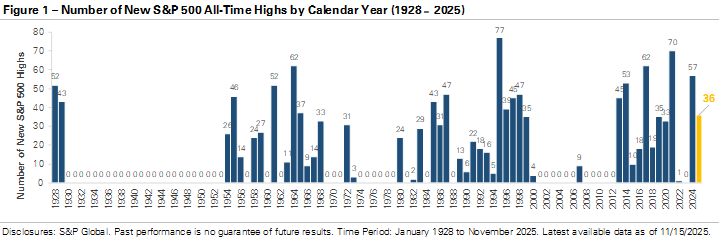
The stock market is having another record-setting year. The chart below shows the S&P 500 has set 36 new highs since the start of the year. While it’s a decline from last year’s pace, the number of new highs in 2025 ranks 18th compared to the past 98 years. The S&P 500’s strong performance this year is part of a broader equity market trend, with multiple other major equity indices also setting new highs. The Nasdaq has logged 36 new highs, the Dow Jones has posted 17, and the small-cap Russell 2000 has recorded six new highs after finally surpassing its 2021 peak.
A combination of themes is contributing to the stock market’s lengthy list of new highs, with the most notable being the artificial intelligence boom. Companies are spending hundreds of billions on infrastructure to train AI models, build data centers, and source the energy to run it all. Nvidia recently became the first company to surpass a $5 trillion market cap, and leading technology firms like Microsoft, Amazon, Alphabet, and Meta are reporting strong growth tied directly to demand for their cloud computing services. The industry’s momentum and forecasts for continued strong growth are driving AI stocks higher, and their large index weights are helping to push the broader markets to all-time highs despite narrow market leadership. To put the rally into perspective, the market-cap-weighted Russell 1000 Index is up +14% year-to-date. The equal-weight version of the index is up +6%, and the median stock has gained just +2%. Beneath the surface, nearly half the index is in the red, with 462 companies down year-to-date.
While AI is getting the most attention, several other catalysts have contributed to the market’s strength. After a 9-month pause, the Federal Reserve restarted its rate-cutting cycle in September, lowering interest rates by -0.50% over the past two months. Lower borrowing costs and expectations for additional rate cuts have provided a tailwind for stocks. At the same time, the U.S. economy has remained resilient in the face of multiple headwinds, including trade policy and tariffs, geopolitical tensions, and a government shutdown. Corporate earnings growth remains strong, and Q3 earnings exceeded expectations.
This year has shown the value of staying invested through uncertainty. Trade tensions and policy uncertainty have created periods of market volatility, and if investors had known the headlines before the year began, they may have been tempted to sell. However, doing so would have meant missing out on the S&P 500’s nearly +15% return and long list of new highs. Timing the market is difficult and often costly, and it can lead to missed opportunities that make it difficult to meet your financial goals. Each year brings its own reminders of core financial planning principles. If 2025 underscored the importance of staying invested, 2026 may highlight the importance of portfolio diversification.
Important Disclosures
Views expressed are as of the date indicated, based on the information available at that time, and may change based on market or other conditions. Investment decisions should be based on an individual’s own goals, time horizon, and tolerance for risk. Investing involves risk, including risk of loss. Investment advisory services provided by Provident Financial Planning, LLC, a SEC-Registered Investment Advisor.
The information and opinions provided herein are provided as general market commentary only and are subject to change at any time without notice. This commentary may contain forward-looking statements that are subject to various risks and uncertainties. None of the events or outcomes mentioned here may come to pass, and actual results may differ materially from those expressed or implied in these statements. No mention of a particular security, index, or other instrument in this report constitutes a recommendation to buy, sell, or hold that or any other security, nor does it constitute an opinion on the suitability of any security or index. The report is strictly an informational publication and has been prepared without regard to the particular investments and circumstances of the recipient.
Past performance does not guarantee or indicate future results. Any index performance mentioned is for illustrative purposes only and does not reflect any management fees, transaction costs, or expenses. Indexes are unmanaged, and one cannot invest directly in an index. Index performance does not represent the actual performance that would be achieved by investing in a fund.
Subscribe to receive the latest blog posts to your inbox every week.
Explore our expertly curated articles offering deeper knowledge and understanding on a range of financial topics.
Guided by our values of faith, service, and transparency, we at Provident Financial Planning are ready to help you navigate your financial journey. Schedule a consultation with us and discover how we can create a personalized financial plan for you.


