


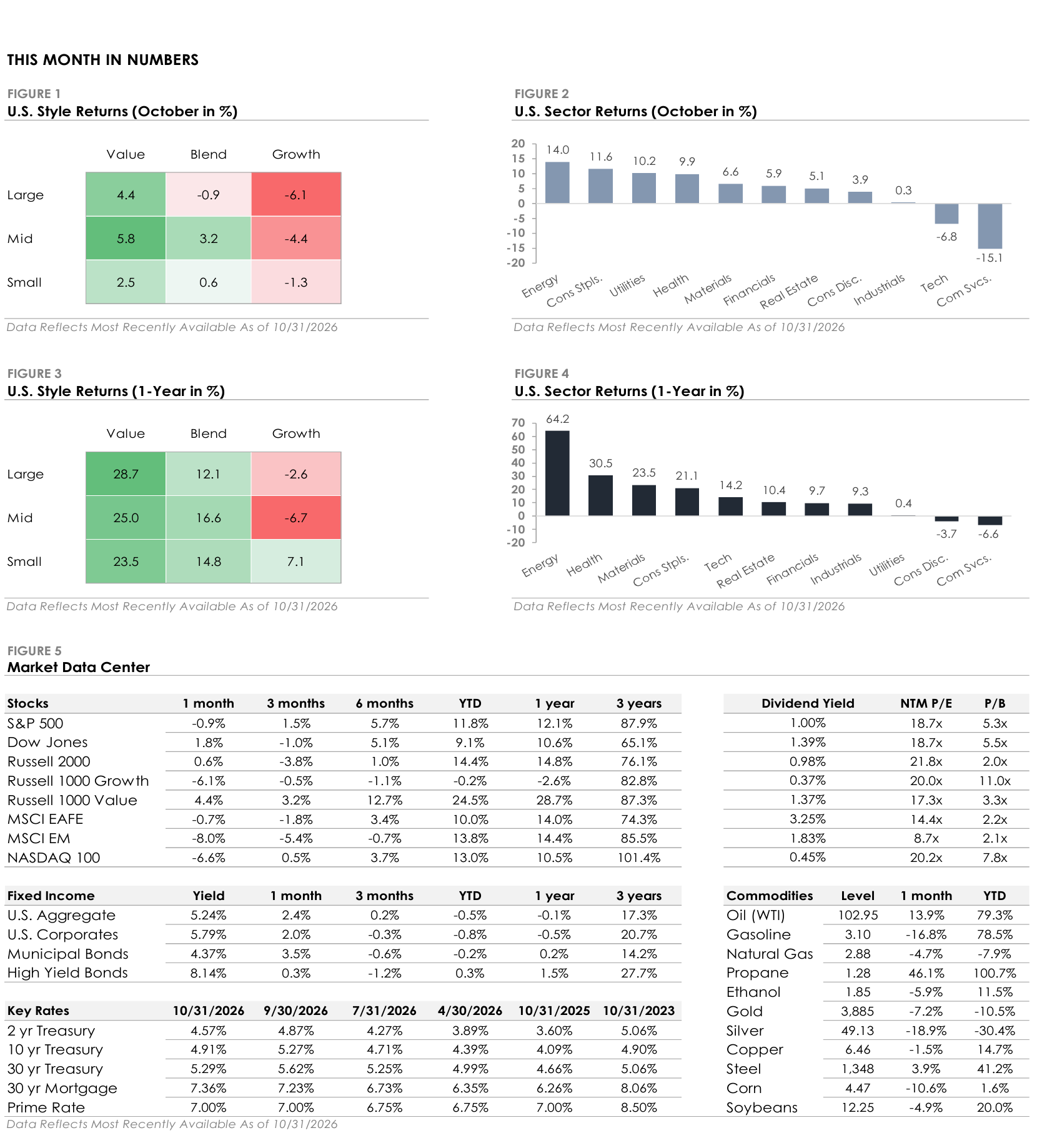
The S&P 500 Index returned -0.9% in October, but the index's decline masked broad strength across the market. The equal-weighted S&P 500 gained +5.0% and Large Cap Value rose +4.4%, while Large Cap Growth declined -6.1% and the Nasdaq 100 fell -6.6% as technology stocks traded lower.
Energy (+14.0%) led all S&P 500 sectors as oil prices rose. Consumer Staples (+11.6%), Utilities (+10.2%), and Health Care (+9.9%) followed, as defensive sectors outperformed. Nine of the eleven sectors traded higher and outperformed the index, while Technology (-6.8%) and Communication Services (-15.1%) traded lower.
Bonds traded higher as Treasury yields declined, with the U.S. Bond Aggregate returning +2.4%. Investment-grade corporate bonds gained +2.0% and outperformed high-yield's +0.3% return as falling yields lifted higher-quality bonds.
International stocks traded lower, led by emerging markets, which declined -8.0% as the selloff in semiconductor stocks weighed on South Korean and Taiwanese stocks. Developed markets were little changed, returning -0.7%.
October was a better month for most stocks than the S&P 500's small decline suggests. The index set a new all-time high early in the month, then traded lower as the largest technology companies came under pressure. The pressure carried into the final day of the month, when a weak outlook from Intel weighed on semiconductor and other AI-related stocks. However, the decline was relatively concentrated, with most of the market trading higher. The equal-weighted S&P 500, which gives every company the same weight, outperformed the traditional index by nearly +6%, the widest margin in a single month since 2009. The performance gap comes from the way the traditional index gives its largest companies the most weight, so a pullback in a handful of mega-cap technology stocks can outweigh gains across hundreds of other companies.
The shift centered on artificial intelligence. Earlier this year, investors began asking whether the heavy spending on AI would pay off. October's earnings reports sharpened that question. Demand for AI infrastructure remains strong, with cloud revenue at the largest technology companies growing rapidly. At the same time, investors drew a clearer line between companies that can pay for their capex with the cash flow their businesses generate and those that rely more on borrowing and issuing new shares. Alphabet's shares fell sharply after its quarterly spending exceeded the cash its business brought in. In contrast, Microsoft's shares held steady after the company reported strong cloud growth and generated more than enough cash to cover its spending. Even after October's market decline, semiconductor stocks are still up more than +50% this year, and the S&P 500 has gained more than +10%. Overall, the month looked less like a retreat from stocks and more like rotation, with gains broadening beyond the largest companies.
After a difficult third quarter, bonds rebounded in October and provided balance as technology stocks traded lower. The month didn't start that way. Treasury yields rose in early October on concerns about inflation and heavy government borrowing, and the 30-year yield reached its highest level in more than two decades. Yields then reversed lower as investors turned to bonds during the stock market rotation. The 10-year Treasury yield ended the month just below 5%, down from about 5.3% in early October. Because bond prices rise when yields fall, the decline lifted bond returns, with long-term Treasuries gaining more than +5%. Corporate bonds also traded higher, led by investment-grade bonds, which benefited most from falling yields. High-yield corporate bonds produced modest gains as corporate credit spreads widened, particularly among the lowest-rated high-yield borrowers.
The Federal Reserve held interest rates steady at its late-October meeting after raising rates in September, though two policymakers voted for another increase. The split reflects a tension that has run through much of this year. The economy remains on solid footing, growing at a +3.4% annual rate in the third quarter as consumers kept spending and businesses kept investing in AI. However, inflation is still running above the Fed's 2% target. Oil prices added to the pressure, rising about +14% in October after attacks on Saudi energy facilities renewed concerns about supply from the Middle East. Against this backdrop, markets expect another rate increase at the December meeting, and the inflation reports between now and then will help shape that decision.
Views expressed are as of the date indicated, based on the information available at that time, and may change based on market or other conditions. Investment decisions should be based on an individual’s own goals, time horizon, and tolerance for risk. Investing involves risk, including risk of loss. Investment advisory services provided by Provident Financial Planning, LLC, a SEC-Registered Investment Advisor.
The information and opinions provided herein are provided as general market commentary only and are subject to change at any time without notice. This commentary may contain forward-looking statements that are subject to various risks and uncertainties. None of the events or outcomes mentioned here may come to pass, and actual results may differ materially from those expressed or implied in these statements. No mention of a particular security, index, or other instrument in this report constitutes a recommendation to buy, sell, or hold that or any other security, nor does it constitute an opinion on the suitability of any security or index. The report is strictly an informational publication and has been prepared without regard to the particular investments and circumstances of the recipient.
Past performance does not guarantee or indicate future results. Any index performance mentioned is for illustrative purposes only and does not reflect any management fees, transaction costs, or expenses. Indexes are unmanaged, and one cannot invest directly in an index. Index performance does not represent the actual performance that would be achieved by investing in a fund.
Subscribe to receive the latest blog posts to your inbox every week.
Explore our expertly curated articles offering deeper knowledge and understanding on a range of financial topics.
Guided by our values of faith, service, and transparency, we at Provident Financial Planning are ready to help you navigate your financial journey. Schedule a consultation with us and discover how we can create a personalized financial plan for you.


