
Each year tends to follow a similar script on Wall Street. Analysts start the year optimistic about how much profit companies will earn, then spend the following quarters trimming those forecasts as actual results come in. Figure 1, which tracks the S&P 500 earnings estimates for each calendar year over the prior two years, shows the pattern. As an example, analysts would start tracking 2026 earnings estimates at the start of 2025, two years ahead of time. For comparison purposes, the starting point for each year is set to 100. The gray dashed line shows the average path over the last 20 years. It slopes steadily down and ends about -8% below where it began, highlighting how analysts often revise their estimates to match results and corporate guidance. In contrast, the two darker lines, which graph the estimates for 2026 and 2027, are doing the opposite. Both have risen more than +10% since tracking began. Analysts are raising their estimates this cycle, not cutting, which stands out against two decades of history.
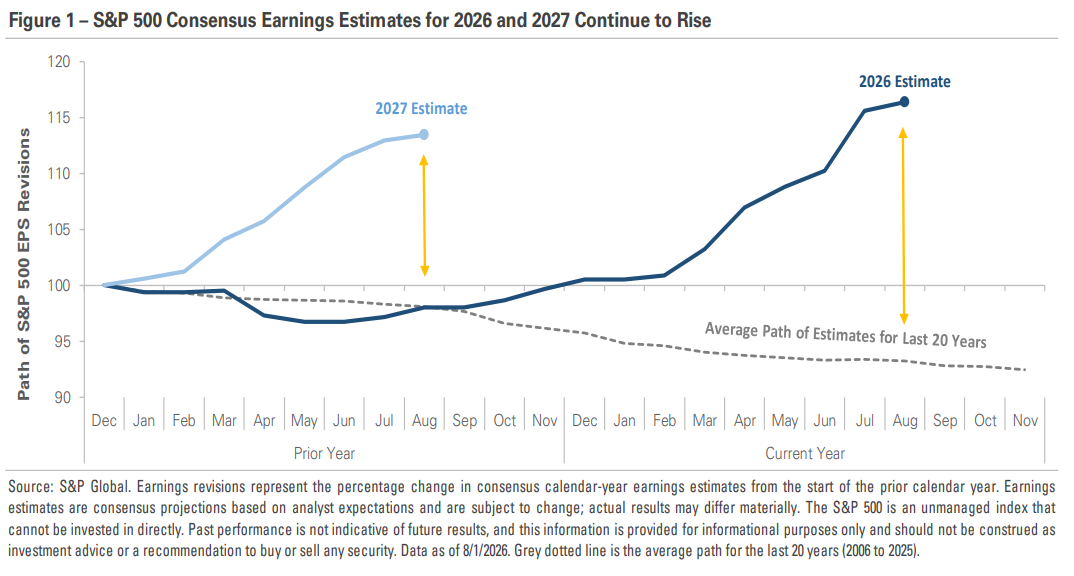
This year is different because actual earnings results have been strong. Analysts have consistently raised their estimates to keep pace with what companies are reporting, with profits repeatedly coming in ahead of expectations. The S&P 500 is on track for its seventh straight quarter of double-digit earnings growth. The technology sector is a major contributor, as heavy investment in artificial intelligence produces sales and earnings growth, but the strength reaches beyond it as well. More than 85% of S&P 500 companies have beaten their Q2 earnings estimates, above the five-year average of 78%. The strength is even more notable given the backdrop, which includes the Middle East conflict, volatile oil prices, and lingering inflation.
The stock market’s strong returns in recent years have been powered by real earnings growth, not just investor enthusiasm. The chart shows that analysts expect the strength to continue, with forecasts calling for another year of double-digit earnings growth in 2027. Much of the outlook rests on the AI buildout, where the largest tech companies are expected to continue spending heavily on infrastructure. Analysts also point to the wider economy, with expectations for steady economic growth and a productivity boost as more companies implement AI in their operations.
However, none of this guarantees a smooth ride. When expectations run this far above normal, they set a high bar. Companies now have to deliver on forecasts that already assume a lot of good news. Volatility along the way is almost certain, but it’s the price of admission for the returns stocks provide. For long-term investors, the point is simple: prices follow earnings, not headlines.
Views expressed are as of the date indicated, based on the information available at that time, and may change based on market or other conditions. Investment decisions should be based on an individual’s own goals, time horizon, and tolerance for risk. Investing involves risk, including risk of loss. Investment advisory services provided by Provident Financial Planning, LLC, a SEC-Registered Investment Advisor.
The information and opinions provided herein are provided as general market commentary only and are subject to change at any time without notice. This commentary may contain forward-looking statements that are subject to various risks and uncertainties. None of the events or outcomes mentioned here may come to pass, and actual results may differ materially from those expressed or implied in these statements. No mention of a particular security, index, or other instrument in this report constitutes a recommendation to buy, sell, or hold that or any other security, nor does it constitute an opinion on the suitability of any security or index. The report is strictly an informational publication and has been prepared without regard to the particular investments and circumstances of the recipient.
Past performance does not guarantee or indicate future results. Any index performance mentioned is for illustrative purposes only and does not reflect any management fees, transaction costs, or expenses. Indexes are unmanaged, and one cannot invest directly in an index. Index performance does not represent the actual performance that would be achieved by investing in a fund.
Subscribe to receive the latest blog posts to your inbox every week.
Explore our expertly curated articles offering deeper knowledge and understanding on a range of financial topics.
Guided by our values of faith, service, and transparency, we at Provident Financial Planning are ready to help you navigate your financial journey. Schedule a consultation with us and discover how we can create a personalized financial plan for you.